BLAZON
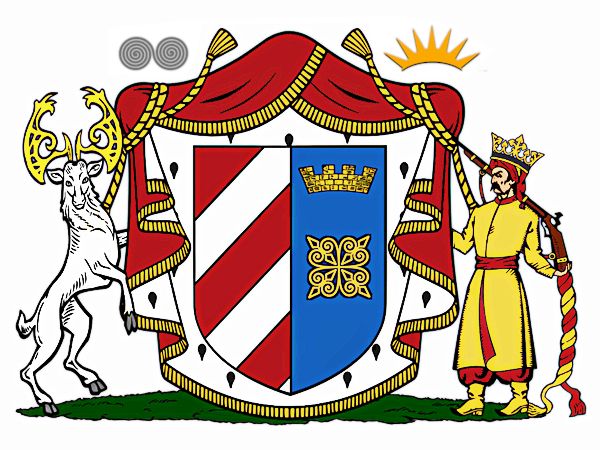
Arms: Per pale, dexter bendy sinister of six gules and argent; sinister azure, in chief a mural crown or, in base an Illyrian solar emblem or.
Supporters: To dexter, a crowned stag argent rampant guardant with coiled antlers; to sinister, a Bosnian harambaša proper in or with gules trim, crowned with a fleur-de-lis crown or, holding a musket and bearing a red-and-gold intertwined cord.
Mantling: A pavilion gules and or of Byzantine form.
Crest: Aurelianic radiant solar crown or, issuant from dexter chief of the pavilion. Two concentric spiral charges argent, issuant from sinister chief of the pavilion, counterpoint to the solar crown.
Compartment: A grassy mound vert.
DESCRIPTION
Escutcheon: Per pale: dexter, bendy sinister of six gules and argent; sinister, azure, in chief a mural crown or, in base an Illyrian solar emblem or. The dexter field contains six diagonal red and white bars, representing an autonomous cadet branch of the Árpáds whose bars were horizontal. The sinister side displays symbols of Dobor's civic autonomy and ancient Illyrian heraldic seal drawn from the ancient Bosnian/Illyrian stećci iconography and museum hydriae (Louvre, Met).
Mantling and Pavilion: A red and gold Byzantine ceremonial pavilion, signifying sovereign dignity, not imperial subordination.
Crest: A radiant imperial solar crown (seven-rayed), issuant from dexter chief of the pavilion, representing Emperor Aurelian's Illyrian ascent to Rome and dynastic continuity through the Claimant. Two concentric spiral charges argent, issuant from sinister chief of the pavilion, placed as a separate heraldic element in counterpoint to the solar crown, echoing the ancient Bosnian/Illyrian stećci iconography, representing the immemorial historical right of Bosnia's two sole indigenous peoples — Bosniaks and Serbs — as descending from the Kakanj and Starčevo cultures of Neolithic Europe, the continent's oldest.
Dexter Supporter: A white Illyrian stag, crowned, antlers stylized into spirals — drawn from the ancient Bosnian/Illyrian stećci iconography and Illyrian mythos.
Sinister Supporter: A Bosnian harambaša in gold and red trim, with a Kotromanić fleur-de-lis crown, musket slung across his shoulders, and red-gold battle cord. Frontier attire emphasizes neutrality and resistance to foreign enemy. The crown symbolizes the Doborski line's continued resistance after the Kotromanićs were extinguished: never submitting, but keeping full sovereignty in arms. The musket represents armed defense of sovereignty, never aggression. The cord symbolizes armed dynastic resistance (e.g., Harambaša Omer Bey's humiliation of Austro-Hungarian forces per Slovenian soldier account).
Compartment: Grassy green mound signifying landed sovereignty — independent from foreign grants or claims.
CIPHER DESCRIPTION
Field: A gradated celestial field, from tenné in chief to or radiant at the base, signifying the descent of divine illumination into temporal dominion. Behind the cipher, a dominant seven-rayed corona in sable, elongated and acute, representing the Aurelianic solar crown and the family's Roman imperial roots and nobility.
Charge: Letters D, I, R — standing for
Doborski, Imperial & Regnal — interlaced in or, imperial and regnal, set within an oval cartouche of elaborate baroque and rococo gold scrollwork, the whole entwined in harmonious symmetry and backed by a radiant early-imperial crown of seven rays or, each ray elongated and acute, issuing upward from the solar brilliance (the divine).
Symbolism: The upper tenné embodies the cosmic origin and the unbroken lineage of celestial right; the golden lower field represents solar vitality and the enduring Aurelian bloodline through which sovereignty is perpetuated. The dominant sable corona of seven rays in the background affirms the family's descent from Illyrian Roman imperial stock, echoing Emperor Aurelian's solar iconography. The absolutely dominating radiant crown of seven rays in or denotes absolutism (the totality of divine order — unity of Heaven and Earth), while the cipher itself affirms rightful dominion by heritage and knowledge (
Scientia in the Dossier's motto).